Showing posts with label strange but true. Show all posts

Tuesday, 5 April 2016

Mission ImPULSEible

Did you know that the United Nations have declared 2016 the International Year of Pulses? Well you do now and rightly so! Pulses are fantastic in so many ways; they're economical to purchase and incorporate into dishes, especially on a student budget (see my easy puy-sy coconut and butternut squash bake it's delicious); they're a high quality protein alternative to meat; and they can be sustainably grown in a variety of climates that do not cost the earth.


I've become so captivated in pulses and nutritious credentials that I decided to focus my Honours Research Project in conjunction with the Global Pulse Confederations LovePulses competition. The competition required team across the world to create a healthy, nutritious, and convenient to eat; which had to showcase one or more pulses. Here's a link for more information on the competition iyp2016.org.


Perhaps it's the illusory effect that Stephen Fry spoke of on QI, but I am noticing more and more food products featuring the power of the pulse. Take a look below at some of my findings.


kettle bites


Kettle Bites Mozzarella & Pesto (rsp: £1.89 for a pack of 5 x 22g)
A recent focus group of mine (as part of my dissertation) concluded that the texture was pleasant, but the pesto was somewhat overpowering and too strong to eat a whole pack. My thoughts were similar, I also found the mozzarella hard to detect.
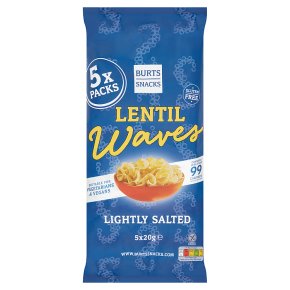

 
Burts lentil waves lightly salted


Burts Lentil Waves, Lightly Salted (rsp: £1.99 for a pack of 6 x 20g)
The focus group compared these to bite size poppadums with more substance. Their plainness lends themselves well as an accompaniment to dips or salsa. I found these completely moreish although they were slightly oily more my liking.


Eis ErdbeerLupinen Drink - NaturLupinen Fusilli


Lupinesse, Germany
I discovered a great website on food futurology called futurefood2050. Here you can discover an exciting array of technologies, innovations and topical issues, such as Food Fraud. One of their favourite themes is FrankenFood in the form of lab grown meat, but that is for another pulse. It’s on this website I discovered research scientist Stephanie Mittermaier, who believes protein produced from sweet blue lupine seeds has big potential as an alternative to soy. German food technologist Stephanie Mittermaier and her colleagues Peter Eisner and Katrin Petersen have developed an interesting array of new product development harnessing the excellent credentials of lupins. They believe that lupins will one day be the alternative for protein instead of conventional meat centric options. I'd love to try their lupin mayonnaise! Watch this space for my own lupin creation (hint hint)!

Monday, 9 November 2015

Orange is the new...green?!

Whilst sitting in my 'Food Product, Manufacture & Supply' lecture last week, our knowledgeable and  gnome sized lecturer Yunus shocked us all when he told us oranges are often dyed to become that golden hue. "Why are oranges called orange then?" exclaimed one of the other students. I thought this was a rather good point and so started my investigation to get to the root of the matter.

What came first, the colour orange or the orange?


The fruit came before the colour. The word “orange” derives from the Arabic naranj and arrived in English as “narange” in the 14th century, gradually losing the initial “n”. This process is called wrong word division and also left us with apron (from naperon) and umpire (from noumpere). Orange was first used as the name for a colour in 1542 (Oldfield and Mitchinson, 2011). 

 The Arabs brought what we now call the Seville orange, or bitter orange, to Sicily in the Middle Ages, and from Sicily it was introduced to the rest of Europe. In the 16th century the Portuguese brought the sweet orange from China, and gave us the fruit which we now know simply as the orange, at first distinguished as a China orange (Oxford Dictionary, not dated).

 Oranges are a subtropical fruit, whose colour depends on where it is grown. In more temperate climes, its green skin turns orange when the weather cools; but in countries where it’s always hot, the chlorophyll is preserved and the fruit stays green (Oldfield and Mitchinson, 2011).  

 The orange fruits are often picked unripe, to develop throughout transport to their final destination. However, green oranges do not indicate an unripe fruit. The greenness is a result of chlorophyll present within the oranges skin. It is only when the fruit is exposed to cold temperatures that the chlorophyll will diminish, leaving the bright golden hue to radiate through.    

Because consumers have come to believe that orange indicates edible, supermarkets have some crafty tricks up their sleeve to transform your fruit. As mentioned earlier, they may shock the fruit with cold temperatures. Other methods include subjecting the fruit to ethylene gas which breaks down chlorophyll. Orange skins can even be dyed if they are not intended or used for processing and meet the maturity standards.

It seemed the history of the fruit was a no-brainer, but nothing is ever straight forward! So don't be put off by green orange residing in your fruit bowl, it's perfectly good to munch on now probably.

References.
Oldfield, M. and Mitchinson, J. 2011. QI: Quite interesting facts about orange. Telegraph. Available from: http://www.telegraph.co.uk/men/the-filter/qi/8345477/QI-Quite-interesting-facts-about-orange.html
Oxford Dictionary. Not dated. Available from: http://www.oxforddictionaries.com/definition/english/orange